

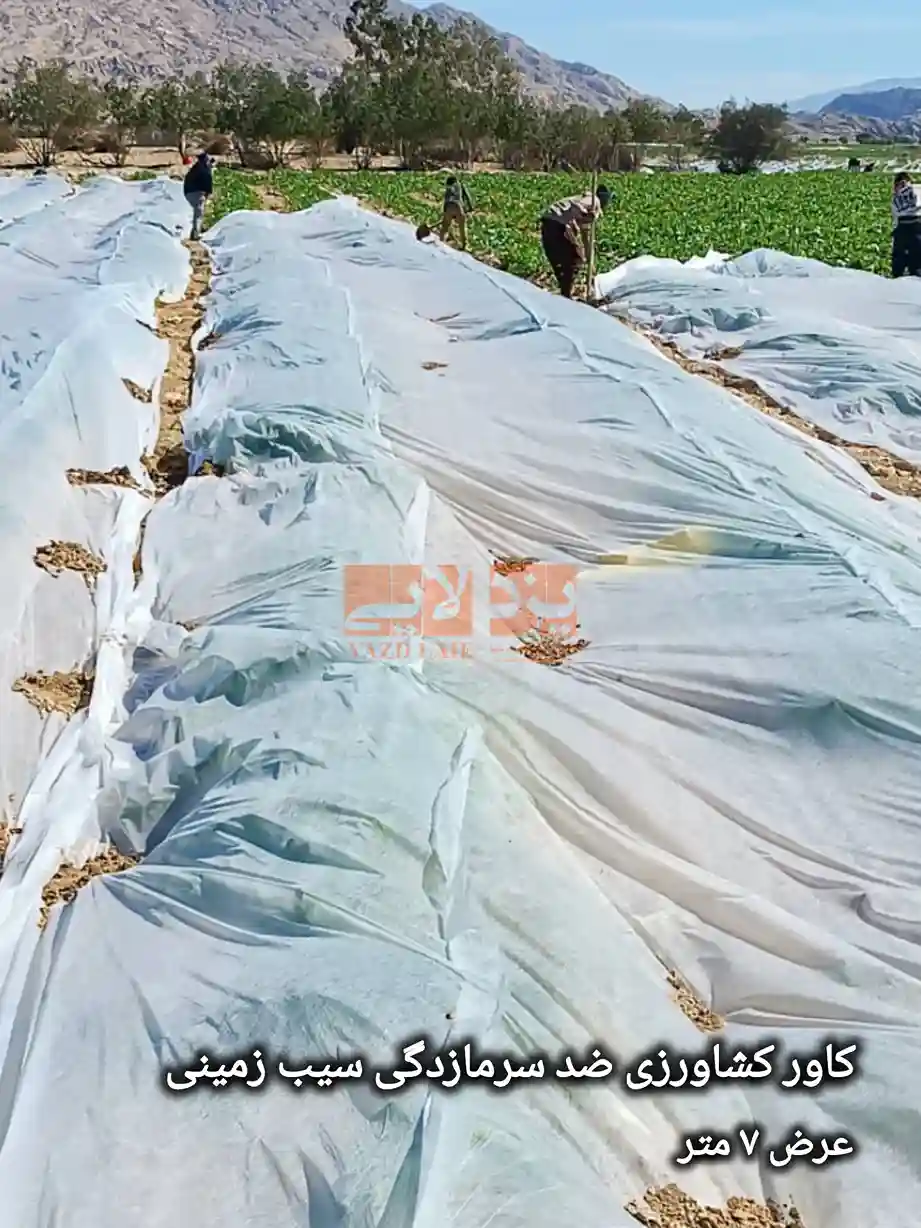
What is an anti-frost agricultural cover for potatoes?
The potato agricultural cover is used to protect potato plants during different stages of planting, growing, and harvesting, ( under both ) cold and hot weather conditions.
The anti-frost agricultural cover for potatoes is a layer placed over the ( foliage) of the plant to protect the crop from environmental risks such as heatstroke and frost. During the warmer seasons, this cover reduces the intensity of sunlight and helps prevent ( pests) like mites, aphids, fungal and viral infections, leaf spots and premature rot.
It also prevents vascular rot caused by the growth of mites and fungi, and in many cases, eliminates them. The potato agricultural cover blocks dust from ( settling) the plant canopy. In cold seasons and during frost, this cover protects crops from cold stress and freezing, ( has proven) highly effective in cities like Jiroft and Kerman.
This cover significantly reduces the need for pesticides and fertilizers and positively impacts environmental health by reducing ( the need for chemicals) , leading to healthier soil and a cleaner environment.
Does the Potato Agricultural Cover Have Other Benefits for Plants?
The potato agricultural cover has several additional benefits. It helps retain soil moisture, which is especially useful in water-scarce areas like Arsanjan, Marvdasht, Jiroft, Kerman, and cities in Fars province and Tehran.
The anti-frost cover also (suppresses weed growth) in potato fields, increases soil temperature, reduces water evaporation, improves irrigation efficiency, and accelerates (potato growth) .
It reduces the exposure of potato tubers to sunlight, preventing excessive greening.
While sunlight is essential for plant growth and sprouting side buds, which are key to increasing yield and plant longevity, harmful UV rays can damage crops, discolor leaves, and cause brown spots or burns.
This specific cover protects potatoes from frost in harsh winter ( regions such as ) Fars, Kerman, Jiroft, Qazvin, and Takestan, and also shields against spring and autumn frosts in provinces like Fars, Tehran, Qazvin, Jiroft, and Kerman. It also protects from pests, hail, and heavy rain. ( this makes it ideal for winter crops intended for early market entry)
( in warmer climates, the same cover) prevents heatstroke and related diseases, and protects against soil pests by raising soil temperature (Furthermore, the cover traps air beneath it, warming the soil in areas with heavy dew and cold climates.
Important ( considerations) for using potato agricultural cover:
( important considerations when using potato agricultural covers) include carefully spreading the cover to prevent it from being ( displaced ) by wind or rain. Irrigation, planting, and fertilization should be (completed) before covering to avoid ( the need for removing and repositioning the cover) . The cover should be applied slightly before cold or hot weather begins, especially in cities like Qazvin, Takestan, Kerman, Jiroft, Fars, Marvdasht, and Arsanjan.
Features of the potato agricultural cover:
۱- The fabric weight (gsm) varies from 20 to 60 depending on the city, season, and intended use.
۲- More durable covers contain UV protection for better sunlight resistance.
۳- They must be firmly fixed to the ground with strong pegs.
It is crucial to buy these covers from reliable and top manufacturers to ensure the best quality, which is best ( ensured by purchasing from reputable suppliers such as ) Yazdlaie Company.
Is using a potato agricultural cover economically beneficial?
Yes. It increases yield per hectare, reduces pesticide and fertilizer, and (conserves water by minimizing evaporation) . It eliminates the need for additional growth enhancers and protective substances like kaolin and Bordeaux mixture, making it highly economical.
How is the potato agricultural cover produced?
These covers are made from polypropylene, ( known for) resistance and elasticity. Yazdlaie Company produces covers in a range of widths from 1 to 7 including 1, 1.20, 1.60, 1.80, 2.45, 5, and 7 meters. The model and width used depend on the farming method (flat field or ridged).
Is Using a Potato Frost Protection Cover Economically Viable?
The (agricultural ) cover is made from polypropylene.
Available roll widths: 1, 1.20, 1.60, 1.80, 2.45, 5, and 7 meters.
The selected width and GSM ( fabric weight) depend on the type of crop, geographic location, and cultivation method.
To withstand sunlight, higher GSM values from 35 to 60 are used in colder regions.
Roll length should be manageable for easy transportation by farmers.
Potato Agricultural Cover Sales:
Yazdlaie Company sells anti-frost potato agricultural covers on a cash basis). The minimum order is one roll, available in widths of 1, 1.20, 1.60, 1.80, 2.45, 5, and 7 meters. A 10% (surcharge) is added for retail purchases. Online and WhatsApp-based sales are also available, or you can visit the factory directly for ( direct ) purchase.
Factors enhancing the durability of the potato agricultural cover:
To enhance durability, UV-resistant materials ( can)be added at 10%, 15%, or 20% levels, depending on the (customer requirements) . This is especially effective in sunny regions like Kerman, Jiroft, Arsanjan, and across Fars province.
Sale of Potato Frost Protection Covers:
Yazd Layei sells these covers on a cash basis, with a minimum order of one roll (widths: 1, 1.20, 1.60, 1.80, 2.45, 5, 7 meters). Retail orders incur a 10% markup on the base price. Online sales are also available via WhatsApp or direct factory purchase.
Factors Increasing the Durability of the Potato Frost Protection Cover:
Adding UV materials at 10%, 15%, or 20% based on customer request greatly enhances performance in high-sunlight areas like Kerman, Jiroft, Arsanjan, and across Fars province.

Herbicide or Mulch
Herbicide is a chemical substance used to eliminate and control weeds. It is used in gardens, farms, green spaces on factories, recreational areas, and hotels. Herbicides ( classified ) selective, systemic, and contact types. However, they are highly harmful to the environment and human health—especially chemical formulations like glyphosate and Roundup.
Mulch, on the other hand, is an environmentally friendly cover that supports nature and all living organisms related to farms and gardens, standing firmly against glyphosate and Roundup. Mulch is made of black nonwoven fabric by Yazdlaie Company, available in weights of 60g/m², 90g/m², and higher upon customer request.
Contrary to popular belief, mulch and herbicides do not serve the same purpose. The essential difference lies in their mode of action. In herbicide application, nature, humans, main crops, and beneficial soil organisms are harmed and contaminated with chemicals. In contrast, mulch poses no risk to nature, human health, crops, or soil life.
While herbicides eliminate weeds, mulch suppresses their growth. The key distinction between the two lies in their approach to weed control and their impact on the environment.
Difference Between Mulch and Herbicide
Mulch:
Mulch prevents the growth of weeds.
It is a physical method of weed control and is available in both organic and inorganic forms.
While weed suppression using mulch may take several years, it offers long-lasting results.
Mulch is safe for human health and. Friendly to environment
Herbicide:
Herbicides kill weeds.
these are chemical method of combating unwanted plants.
Herbicides act quickly, but the effect is temporary.
They harm crops and beneficial soil and airborne organisms.
negative effects of Herbicides
Herbicides like glyphosate and Roundup pollute soil and water, contaminating underground water sources.
They reduce biodiversity, posing serious risks to ecosystems.
Some herbicides destroy not only harmful plants but also beneficial ones, even drying out crop roots over time.
Farmers often blame climate change and drought, unaware that herbicides are disrupting ecosystems.
when Toxic plants consumed by animals and birds, it can lead to death and ecosystem imbalance.
Useful insects like bees and ladybugs are killed.
Excessive herbicide use creates resistant weeds, making them harder to control.
Direct inhalation of banned herbicides like Roundup (still used illegally) and glyphosate severely damages the lungs, causes cancer, weakens the immune and nervous systems, and leads to respiratory illnesses.
Another risk is chemical residue in fruits, vegetables, and grains due to overuse of herbicides.
Irresponsible farmers increase doses due to weed resistance, thereby increasing costs and health hazards.
These toxins accumulate in the liver and cause disease.
Mulch, on the other hand, poses none of these risks—it naturally suppresses weeds, and produces healthy, chemical-free crops.
Therefore, based on the above comparison, any rational reasonable person concludes that Yazdlaie’s fabric mulch is an excellent alternative for weed control.
Sales channels:
Mulch is sold through several methods:
– Direct sales from the factory,coordinated by sales experts
– Phone orders via Yazdlaie factory in Yazd Industrial Town with delivery via freight companies
– Online sales through social media and Yazdlaie website with assistance from sales experts
Yazdlaie Company, as a part of its environmental protection initiative, began producing weed mulch—becoming the first company in the country to do so.
Its mission is to save soil, water, and underground resources.
In contrast, herbicide manufacturers harm the land and valuable underground assets, replacing beneficial insects and soil organisms with harmful chemicals.
Our environment is being damaged by these herbicides that pollute water and destroy underground reservoirs.
Thus, to protect our land and ensure future generations have clean resources, mulch should be the preferred choice.
If we care about our health and wish to avoid respiratory and liver diseases caused by chemical sprays, all farmers should unanimously reject herbicides and adopt healthy alternatives like Yazdlaie’s mulch.
Which Is Cheaper: Mulch or Herbicide?
Purchasing either mulch or herbicide requires investment.
Herbicides prices from 600,000 to 3,000,000 Tomans per liter.
Fabric mulch, sold by weight, costs 180,000 Tomans per kilogram—significantly less than the cheapest herbicide.
Depending on weed type and herbicide resistance, product selection and cost can vary.
In agriculture, land is a fixed asset, but input costs (like spraying, fertilizing, plowing, and pruning) are variable.
To reduce variable costs, it’s better to replace herbicides with mulch.
Weed mulch not only reduces initial costs but also saves long-term expenses by eliminating the need for repeated herbicide purchases, labor, tilling, and tractor work.
Additionally, herbicide use incurs long-term health costs due to respiratory and liver issues , affecting farmers who regularly use these chemicals.
Treating these illnesses leads to significant emotional and financial burdens.
Price Comparison Between Herbicide and Mulch
To compare costs of products that serve the same purpose, consider this:
For one hectare Super Gallant, Roundup, and Paraquat are used at 80L, 50L, and 20L, respectively.
Prices per liter are 400,000, 500,000, and 800,000 Tomans.
Total cost per hectare: 32M, 25M, and 16M Tomans.
with an additional 20M Tomans for labor, the total costs become 45M, 36M, and 52M Tomans per hectare.
You might think herbicides are cheaper than mulch.
However, herbicides carry hidden costs. For example, soil requires expensive fertilizers, humus, and rooting agents to recover.
Weed resistance increases dosage yearly.. When future medical cost due to herbicide exposure are considered, the long-term expense becomes significantly higher
Weed cover refers to a non-woven fabric that is spread over weeds to stop the vegetative and reproductive growth of the weeds, drastically reduce their photosynthesis, weaken the plant, prevent growth, and even cause soil-borne seeds to lose their viability.
Why is weed cover essential for farmers and growers?
One of the major concerns for farmers in spring is the invasion of weeds with beautiful and fragrant flowers, which can be difficult to control. Especially in fertile areas like northern and northwestern Iran, southern coastal cities, and humid regions, their growth rate exceeds farmers’ management capacity. This leads to high variable costs, making the use of weed covers essential.
How does a black weed cover eliminate weeds?
This black weed cover works based on simple physics — black is the only color that absorbs the full spectrum of light and does not allow light to pass through. This reduces photosynthesis and warms the weed cover. It also acts as a barrier to vertical growth. By retaining soil moisture, the main crops grow better than weeds.
Improving soil quality with weed covers:
When the weed cover is placed on farm soil, the weed’s activity mechanism changes — sunlight, necessary for photosynthesis, doesn’t reach the plant, thus disrupting photosynthesis and halting growth. With weed cover, farmers don’t need to purchase herbicides. In contrast, chemical fertilizers reduce the number and lifespan of beneficial soil organisms, weakening the soil. The weed cover also prevents water evaporation and transpiration, reducing irrigation frequency during dry seasons. As water is crucial for plant survival and water scarcity is worsening, this cost-effective cover helps address the water shortage by preventing moisture loss and extending plant survival in dry conditions.
Types of weed covers available in the market
- Organic weed cover: Made from nature-friendly materials, they degrade quickly or are consumed by animals, so they have low durability and require replacement.
- Non-organic weed covers: Available in various types.
- Plastic weed cover: Blocks airflow, which can cause fungus around roots and lead to rot, especially in shallow-rooted crops.
- Yazdlaie fabric weed cover: Offers many advantages over plastic ones. With 10-micron pores, it allows air exchange under the cover, keeping soil and roots safe from fungal diseases.
Advantages of weed cover:
- Maintains soil moisture for extended periods.
- Interrupts photosynthesis by reducing sunlight exposure to weeds.
- Reduces additional variable costs.
- Improves product quality by lowering chemical use and enhancing fruit aroma and flavor.
- Prevents soil erosion caused by heavy rain and machinery.
- minimizes day-night temperature fluctuations on the farm.
How is weed cover supplied to the market?
Weed cover prices vary with raw material costs, but are generally economical considering the benefits for soil and crop quality.
Can weed cover be used in greenhouses?
This excellent product is suitable wherever plants exist. In greenhouses, it blocks harmful sunlight in summer, preserves thermal energy from the floor in winter, and eliminates weeds all year round. It also prevents sprayers and their operators from entering, reducing the spread of diseases. Furthermore, it eliminates weeds that harbor pests like mites, thereby drastically reducing pesticide and fertilizer use.
In which areas of agriculture is weed cover used?
Weed cover is commonly used in all agricultural sectors — oil plant factories, large fruit orchards, and extensive vegetable and melon farms.
Technical specifications of weed cover:
- Material: Polypropylene
- Roll width ranging from 1m, 1.20m, 1.60m up to 7m
- GSM: 60g/m² and 90g/m²
- Roll length: Typically 1000 meters, may vary
How is the required amount of weed cover determined?
The required width and length depend on row spacing, plant type, and the canopy diameter of trees in the field or orchard.
Weed cover sales:
Yazd Laie sells weed covers in cash transactions. The minimum sale amount is 500-meter rolls with 1.60m width and 60 GSM. Bulk sales are available for larger demands and custom widths.
How to increase the durability of weed covers:
The more UV stabilizer is added and the thicker the cover, the more resistant it becomes to natural and physical damage. Proper use and careful handling- such as avoiding sharp tools- also significantly increase its lifespan.