
Yazd Laie Agricultural Cover: From Protecting Field Crops to Covering Several Trees at Once
A solution for today's farming, with standard, wide and ultra-wide covers up to 20 meters
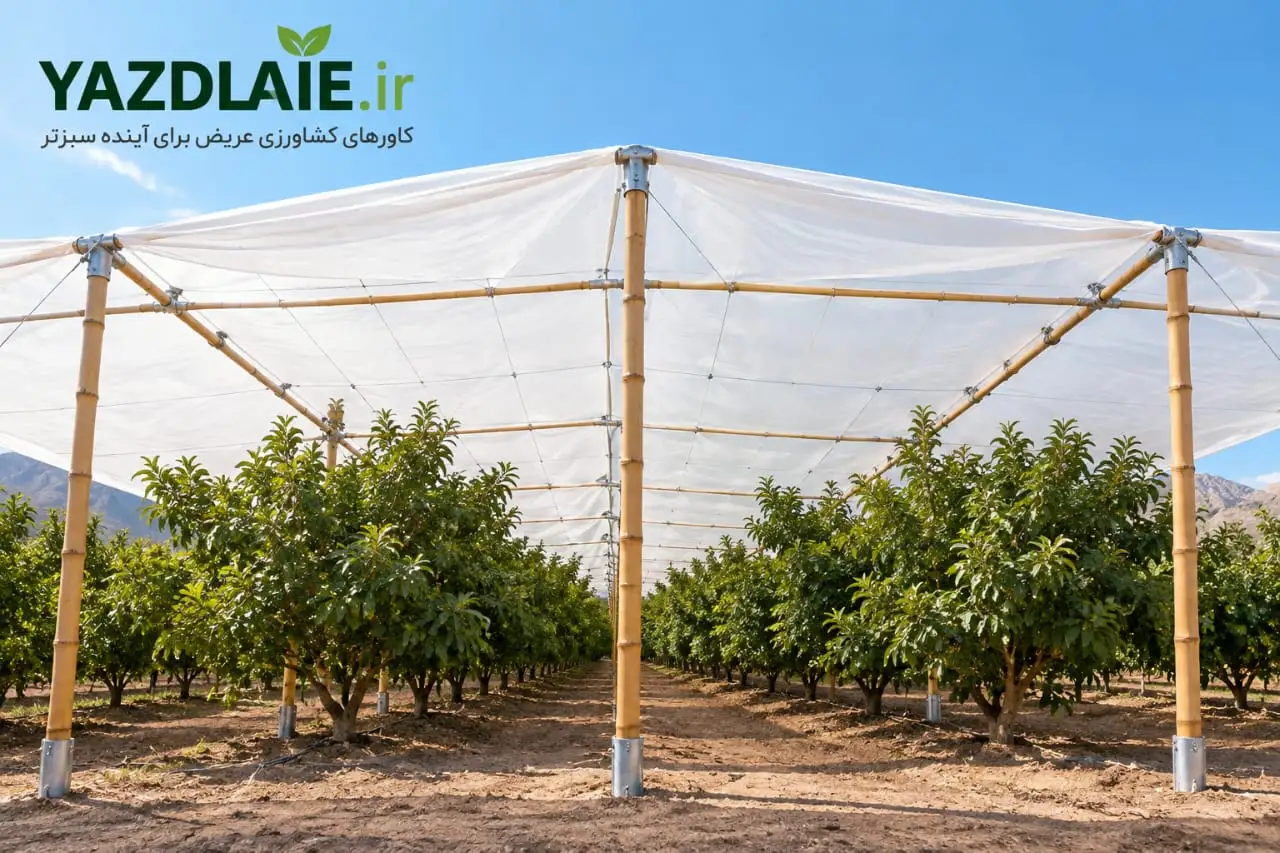
When cold approaches the farm and orchard
For a farmer, cold is not just a change in temperature; it is a worry about a crop that has taken months of time, money and effort. In such conditions, having a cover suited to the type of crop and the size of the land can be an important part of a plant protection plan. Yazd Laie agricultural cover is offered with exactly this view: choosing the right width for what the farmer really needs in the field or orchard.
The needs of a tomato farm are not the same as those of an orchard with tall trees. Sometimes a limited row has to be covered, and sometimes several rows or several trees must be placed under cover within one shared area. That is why Yazd Laie offers agricultural cover in three groups, so the product is chosen based on growing conditions, not just a fixed number for the roll width.
Three groups of Yazd Laie agricultural cover
The group boundaries in this table are Yazd Laie's product categories for easier introduction and selection. The final suitable width is determined by the type of crop, the dimensions of the land and the installation method.
| Product group | Introduced widths | Suggested use |
|---|---|---|
| Standard | 1.80, 2.40 and 3.20 m | Limited and row covering |
| Wide | 5.20, 5.60 and 7 m; under 10 m | Larger areas and rows |
| Ultra-wide | 10, 13, 18 and 20 m; group from about 10.20 m up | Large areas and orchard projects |
Why does width variety matter?
Instead of being forced to fit the farm to one limited width, a farmer should be able to choose a cover that suits their planting layout. On some land a standard cover is enough; on other land, a wide or ultra-wide cover can reduce the number of separate pieces and make it possible to cover a larger area. Of course, the wider the cover, the more important it becomes to plan how it is unrolled, pulled, anchored and collected.
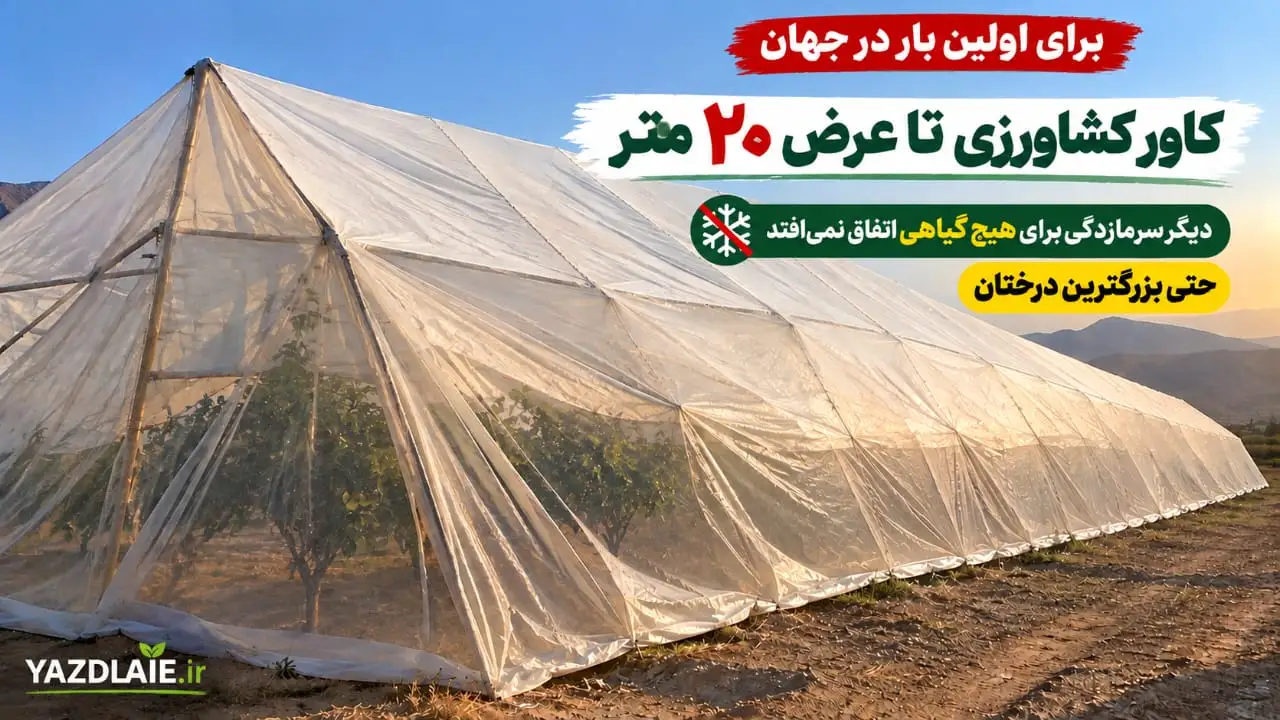
Standard and wide covers: choosing to match the growing method
Standard agricultural cover: a familiar solution for limited rows
Yazd Laie standard covers are offered in widths of 1.80, 2.40 and 3.20 meters. This group suits situations where the farmer wants to cover a specific area of plants or planting rows and wants the cover to be easier to move. Choosing the right width at this stage can prevent extra work during installation.
In field crops, the type of crop, row spacing and irrigation method all affect the choice of width. That is why no single version is recommended for every farm. In presenting its products, Yazd Laie pays attention to the farmer's real conditions, from tomato and potato fields to other crops such as lettuce, cabbage and eggplant.
Wide agricultural cover: when the covered area gets bigger
The second group includes wide covers with widths of 5.20, 5.60 and 7 meters, and in general widths under 10 meters. This group sits between standard covers and ultra-wide products; it is for when the farmer wants to cover more area with a single piece of cover, while the installation and handling method still matches the farm's resources.
One point that has mattered in Yazd Laie's market experience is farmers' strong interest in widths close to 10 meters, alongside their concern about how hard it is to unroll 13- and 20-meter widths. This shows that choosing a wide cover should go hand in hand with assessing labor, wind conditions, row length and how the cover is spread out.
Bed planting and large areas: where the view of width changes
In crops where plants are closely spaced or a large area is planted in beds, using a wider cover can be attractive in terms of coverage. On such land, the issue is not just covering a single row; it is protecting a continuous surface. Even so, being wider does not by itself mean being more suitable for every farmer.
Yazd Laie's recommendation is to prepare a simple map of the land, the row spacing, the required length and the installation method before choosing a width. The result of this review shows whether a standard, wide or ultra-wide cover is the more sensible choice.
Ultra-wide agricultural cover: bigger coverage for bigger ideas
From 10 meters wide to a 20-meter cover
In its ultra-wide cover group, Yazd Laie introduces the key widths of 10, 13, 18 and 20 meters. This group is meant for projects where a farmer or orchard owner wants to cover a larger area with one shared cover. The 20-meter cover is the highlight of this collection; a product that Yazd Laie has manufactured and used in a real orchard installation.
A large width is not a goal in itself. The value of an ultra-wide cover becomes clear when there is a specific use for it: covering several closely spaced rows, a large planted area, or part of an orchard where several trees are meant to sit under one cover.
Why is spreading very wide covers a real challenge?
At large widths, pulling the cover over the ground or over a structure in one go requires more coordination. Wind can make the job difficult, and along the length of the roll you may need more labor and proper anchoring. This has been one of the concerns Yazd Laie has faced in conversations with farmers and while developing the product.
So customers should not be promised that every 20-meter cover opens easily on any farm. The installation method should be planned from the start according to the roll length, the free space around it, wind conditions and the number of people doing the work. For orchard projects, a supporting structure is also part of the solution.
A shared cover instead of separate covers
One of the most attractive capabilities of an ultra-wide cover is the ability to create a shared protected space. Instead of each tree necessarily being covered separately, a suitably designed structure can place several trees under one cover. In this approach, the cover is not just a product for sale; it is part of a practical solution for the orchard owner.
At Yazd Laie, this idea has gone beyond the concept stage. The 20-meter cover has been installed in a real project on a structure made of bamboo and steel cable, to test and demonstrate the possibility of covering trees under one shared roof.
Which orchards can consider this solution?
In Yazd Laie's market development plan, orcharding has a special place. Almond orchards and other orchards where tree size and row spacing allow a suitable structure can be considered for this solution. The final decision should be made after a site visit and measuring tree height, row spacing and the space needed for installation.
Yazd Laie's real project: a 20-meter cover on a bamboo structure
How was covering the trees made practical?
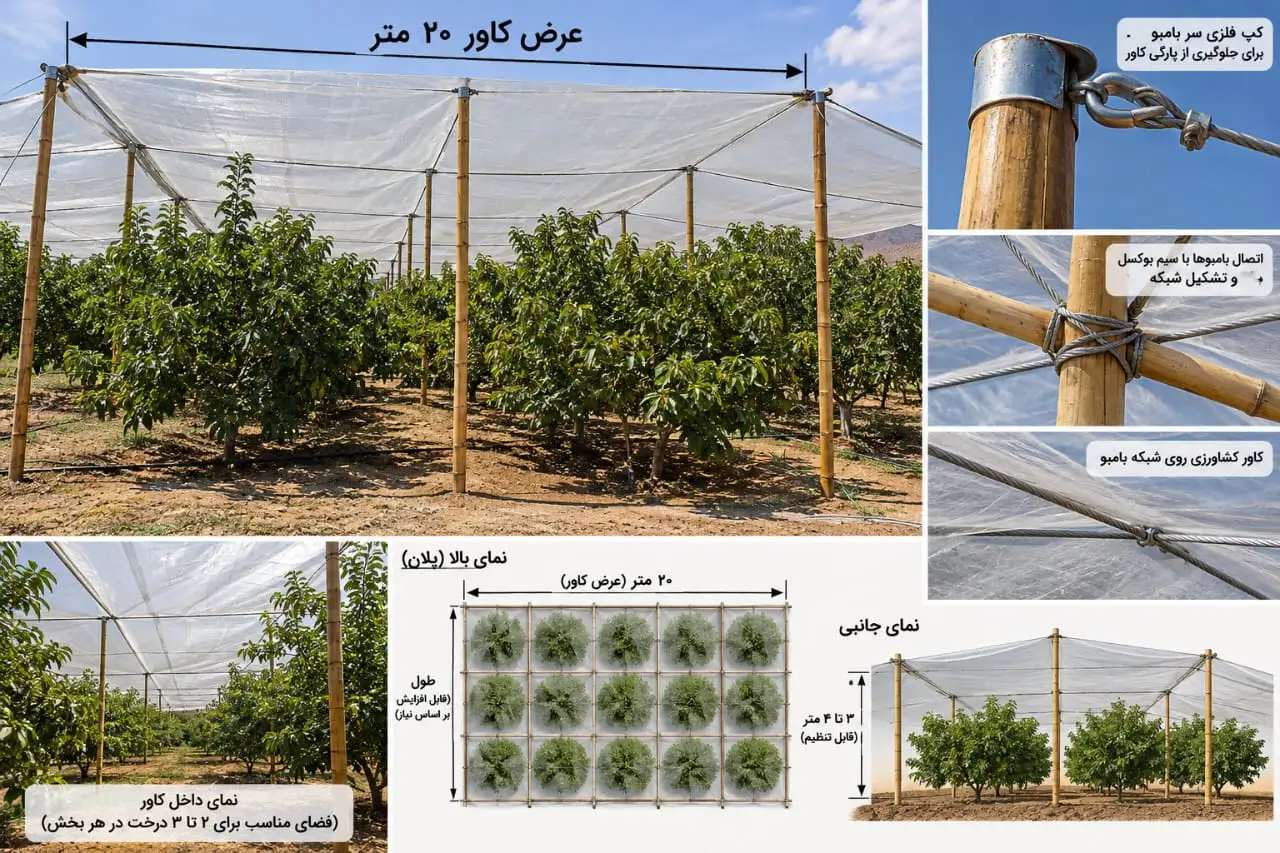
To install an ultra-wide cover over trees, Yazd Laie concluded that the cover should not rest entirely on the branches and crowns of the trees. In the completed project, bamboo poles were used and connected to each other with steel cable to form a network that holds the cover.
Metal caps were installed on top of the bamboo poles to make the contact point between the structure and the cover more suitable and to reduce the risk of damage and tearing from direct contact with the bamboo tips. The 20-meter agricultural cover was then spread over this network, and the space beneath it was planned to hold several trees.
Three main components of an orchard installation
- Bamboo
the supporting poles of the structure that provide the height needed to place the cover above the trees. In the designs Yazd Laie has discussed, bamboo poles with a diameter of about 7 centimeters have also been considered.
- Steel cable
the link between the poles that forms the supporting network above the orchard. The purpose of this network is to provide a support path for the cover along the length and width of the installation area.
- Metal cap
a piece on top of the bamboo that makes the contact point suitable and reduces the risk of damage to the fabric. These small details matter in a real installation, because the cover has to stay intact during installation and throughout its use.
Several trees under one cover
In the example Yazd Laie installed and filmed, the space under the cover was planned to cover about two to three trees at the same time. The main goal was to show that ultra-wide cover can be used in orchards, rather than being limited to bushes and low-growing crops.
In planning for an almond orchard, row spacing of about 5.3 meters and trees about 6 to 7 meters tall were also discussed. These figures are specifications discussed when reviewing the project and should not be used as fixed dimensions for all orchards without measuring.
Real footage of the project: the most important part of introducing the product
This project is not just a graphic design. Yazd Laie has filmed its real installation. For presenting it on the website, showing the outside view of the cover, the extent of the coverage, how the structure is placed and the orchard space is very important. Real images of the project can help orchard owners better picture the final result before ordering.
How to choose the right cover for your orchard or farm?
Start with the type of crop, not the largest width
The first question is what is to be protected: limited crop rows, a large planted area, or several trees in an orchard? The answer to this question clarifies the path to choosing. For some land a 2.4-meter cover is enough; for others, widths of 5.6 or 7 meters are more suitable; and for special projects you can turn to widths of 10, 13, 18 or 20 meters.
What information should be ready before ordering?
The width and length of the target area, the type of plant, row spacing, tree height in orchard projects, wind conditions on site and the intended method for installation and collection are the information that makes your conversation with sales experts more precise. For ultra-wide covers, having photos or video of the land can also help with the initial assessment.
The goal is to reduce frost risk, not to make unrealistic promises
Agricultural cover is used to help protect plants in adverse conditions, especially cold. However, the level of protection depends on the severity and duration of the cold, environmental conditions, the type of plant and the quality of installation. Therefore, no width on its own guarantees that frost damage will be completely prevented in all conditions. Choosing the right product and installing it properly are an important part of a good result.
Why Yazd Laie?
Khaneh Nabafteh Jahan Company, under the Yazd Laie brand, offers wide and ultra-wide products alongside standard agricultural covers. The development of this collection began with responding to the needs of farms and has continued up to producing a 20-meter cover and installing it for real on an orchard structure. This experience allows Yazd Laie to talk with customers about the practical needs of large covers, beyond simply giving a number for the product width.
For a farmer looking to protect their crop, the most important thing is choosing a cover that fits their land and their installation resources. For an orchard owner who wants to place several trees under one shared cover, reviewing the structure and the installation method becomes even more important. Yazd Laie pursues both of these needs in its range of agricultural products.
For consultation and ordering agricultural cover
If you need a standard, wide or ultra-wide cover for your farm or orchard, discuss your land dimensions and crop type with Yazd Laie's experts so the right width and its installation considerations can be reviewed. To learn about the 20-meter orchard cover project, you can also view real images and footage of Yazd Laie's installation on the website.